KABOOM FIELD GUIDE
Big bases, smooth fights: why KABOOM uses limits
Building a fortress and defending it all wipe is part of the fun. So is a raid where movement, shooting and looting feel responsive. Limits help leave room for both.
Verified November 9, 2026
Big bases. Smooth fights.
Why building and turret limits exist
What do you mean by lag?
Players use the same word for several different problems. A dense base can put pressure on the server and on nearby players' PCs, through different systems. A network problem can feel similar without having the same cause.
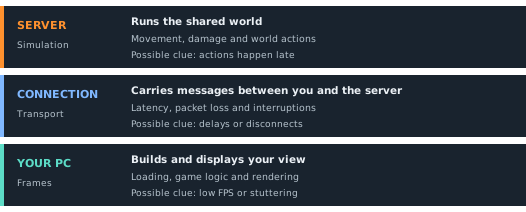
Your FPS can fall near a compound while the server is running well. Your FPS can also stay high while server actions arrive late. These symptoms are clues, not a diagnosis: location, timing, connection quality and actual server measurements matter. [1][4]
A quiet server can still have a busy map
Player count tells us how many people are online. It does not tell us how many buildings, defenses and automated systems have accumulated. Those objects do not disappear when their owners log off. A weekly wipe gives structures more time to grow between resets.
That is why 'there are only a few players online' cannot, by itself, tell us how much building or turret capacity is sensible. This is a reason to keep headroom, not a claim that every large base causes lag.
1000X changes the equation.
The usual brakes on building are much lighter here
Battlefield servers deliberately make it easy to get back into action. In vanilla Rust, gathering ingredients, unlocking blueprints, reaching a workbench and waiting through crafting queues slow down how quickly players can produce equipment and deployables. The current game code still contains those checks and timers. [9]
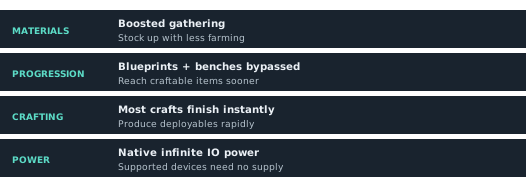
These shortcuts are part of KABOOM's appeal. They also let a small group create a lot of structures and defenses quickly. High gather and instant crafting do not make each placed object cheaper to simulate or display; they make it easier to create more of them. [9]
Free power can save the extra entities used for power generation and wiring. At the same time, it removes much of the setup effort for another powered device. Its gameplay convenience does not remove that device's targeting, state updates or other behavior. [2][3][9]
Fast progression still needs headroom
This is the practical challenge for a high-rate server: many of vanilla's natural speedbumps are reduced while the resulting objects still use the game engine. Building and turret limits are one way to keep that rapid growth manageable without taking away the fast rebuilding that players came here for.
A '1000X' gather rate is not a claim of 1000 times the CPU load or 1000 times the number of entities. What matters is what players actually place, how densely they place it and what those objects are doing.
A turret has work to do.
Even when nobody is pressing a button
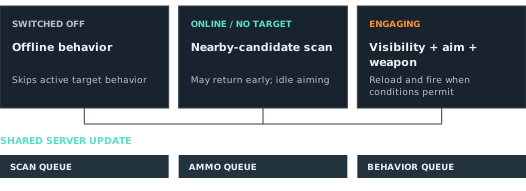
In the current Rust server code, an auto turret has scheduled updates and separate queues for target scanning, ammunition updates and its main behavior. When it has a target, that can include line-of-sight checks, aiming, reloading and firing through its attached weapon. [2]
Rust already avoids a lot of unnecessary work
Scanning uses a nearby trigger's contents, with checks that can return early. Ammunition refreshes are queued when marked dirty. Aim-direction messages check for subscribed players and whether an update is needed. An offline turret skips active target behavior. It is cheaper in that respect, but its placed entity and scheduled callbacks still exist. [2]
The scan, ammunition and behavior queues run from the main server update with separate time budgets. Queues spread work out; unfinished work can wait for another pass. Extra CPU cores do not automatically split these update paths between them. Rust does use parallel work elsewhere: the current player-update code explicitly sends some visibility work to the thread pool. Spare cores and a busy game thread can coexist. [2][3]
Walls and machines have different costs
A wall is not another auto turret. Building stability uses cached values and queued checks; a changed support can cause connected pieces and neighboring objects to be reconsidered. Electrical output updates also use queues. A quiet structure, a collapsing structure and a base full of changing machinery are different workloads. [3]
'Entities' means many kinds of world objects, not just walls. An entity count is a useful size indicator, but it is not a price list where every object costs the same amount of CPU time. Carbon activates hooks as needed, but ordinary synchronous plugin handlers still run inline with the event that called them. Carbon does not automatically give each plugin a worker thread. [3][8]
Where things are matters.
The same object count can create different experiences
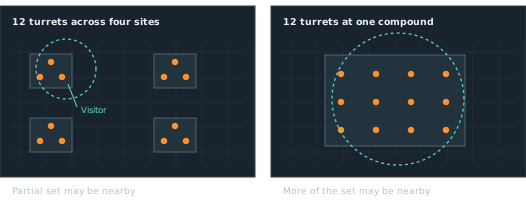
A concentration of buildings and deployables can put more objects in one player's nearby scene. Overlapping turret engagement areas can also make several turrets consider the same nearby threat. Spreading objects out changes who encounters them; it does not remove their server-side cost. The actual result depends on activity, layout and the player's hardware. [1][2][4]
The client has its own work to do
Your PC has to load and display the relevant parts of a base. Rust has visibility, level-of-detail and batching optimizations to reduce that work, so 'every wall is drawn separately all the time' would be wrong.
Facepunch's November 5, 2026 update specifically improved hitches around bases: smoother detail-level updates, fixes for objects staying visible too far away, and fixes for building blocks missing render batching. The same update moved industrial pipe mesh generation off the main thread. Those are real improvements, not a guarantee that any base size will be smooth on every PC. [4]
Why we cannot promise a magic safe number
There is no verified conversion such as 'one turret costs one FPS' or '5,000 blocks are always safe.' Server hardware, other activity, nearby targets and client settings change the result. We verified the code paths described here; we have not benchmarked an FPS loss per turret or proved that a particular player's base caused a particular lag spike.
Limits are an operating choice that reserves room for fights, raids and everyone else's builds. KABOOM also needs to optimize plugins and investigate actual performance problems. Limits do not replace that work.
What the turret limit means.
Current KABOOM placement rules / verified November 9, 2026
A connected structure starts with an allowance of 10 auto turrets. It scales up gradually, reaching 40 at 5,000 qualifying upgraded building blocks. Intermediate allowances round down. This is a KABOOM rule, not an engine performance threshold. [5] The 5,000-block marker is where the turret allowance stops increasing; it is not a general building-size cap.
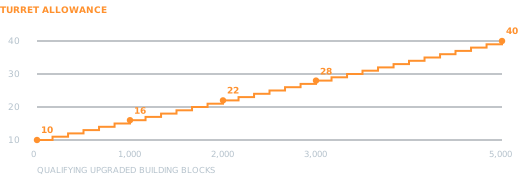
The scale counts qualifying foundations, floors and walls above twig grade. It does not count every deployable, and it is per connected structure rather than per player, clan or TC authorization list. The turret must be placed on connected structure support so that structure can be identified. [5]
The plugin checks when a player tries to place a turret. It counts existing living turrets on that structure, including switched-off ones. It blocks the new placement at the allowance; it does not continuously patrol bases or delete an existing excess. Passing this check does not bypass Rust's other placement checks. [5]
Placement allowance and interference are different
Rust also has a native nearby-turret interference system. Our current settings are a 40-metre neighborhood and an interference limit of 12. Nearby activation state and layout affect which turrets can acquire targets. An allowance of 40 placed turrets does not mean 40 turrets packed together can all acquire targets normally. [2][6]
On KABOOM, flip the switch on the front of the turret to turn it on. Authorization, ammunition, a valid weapon and native interference still matter. [7]
Help us investigate the right problem
Report your map grid and approximate time. Say whether your FPS dropped, actions were delayed, or you disconnected, and whether it happens only near one base. Use /kaboomai in game, or contact support in Discord. Specific observations help us investigate without guessing that every slowdown has the same cause.
Sources and verification
Verified November 9, 2026 against the installed Rust server, Carbon and current KABOOM plugins. Code paths establish what work exists; they do not measure a universal CPU or FPS penalty.
[1] Rust networking: nearby subscriptions
Current production Assembly-CSharp.dll: BaseNetworkable.ShouldNetworkTo, SendNetworkUpdate and HasConnections; AutoTurret.SendAimDir. Entity subscriptions and message conditions are not the same thing as client rendering or simulation cost.
[2] Rust auto-turret behavior
Current production Assembly-CSharp.dll: AutoTurret.ServerInit, TargetScan, ServerThink, RunScheduledTick, TargetTick, ObjectVisible, SendAimDir, AddNearbyTurrets and ShouldTurretOverload; ServerMgr.Update. Budgeted scanning, ammunition and behavior work; native interference.
[3] Building changes, IO and shared execution
Production Assembly-CSharp.dll: ServerMgr.Update processes turret queues and IOEntity.ProcessQueue. StabilityEntity caches and propagates support changes. BasePlayer.ServerCycle calls ServerUpdateParallel; GatherOcclusionPairsChunk explicitly switches to the thread pool. Matching production Carbon HookCaller code invokes ordinary synchronous hooks inline.
[4] Facepunch: Printed and Polished
November 5, 2026. Primary source for current client-side base-loading, LOD, batching and pipe-mesh improvements. These are Facepunch's findings, not KABOOM benchmarks.
Primary source[5] KABOOM placement policy
Live KaboomTurretLimits 1.0.5 source, config and turretlimits.status read on November 9, 2026. EligibleBlock, Allowance, ResolveBuilding, CountCompleted, CountTurrets and CanBuild. No recurring scans; new-placement enforcement.
[6] Native interference: live settings and original design
October 5, 2023 introduces the system. Current behavior was rechecked in the production assembly, with live sentry.maxinterference=12 and sentry.interferenceradius=40; the old article is not being used as proof of today's code.
Primary source[7] KABOOM turret power switch
Current live TurretSwitches 1.7.0 source and configuration: attached front switch and OnTurretStartup gate. Enabling power does not bypass native targeting conditions.
[8] Carbon's dynamic hooks
Framework documentation confirms unused hooks are not all kept active. Matching installed HookCaller code confirms synchronous dispatch. Plugin count alone does not measure their execution cost.
Primary source[9] High-rate progression and power: current KABOOM mechanics
Production ItemCrafter / PlayerBlueprints retain native craft timers and blueprint/workbench checks. Live InstantCraft 2.2.8 plus default instantcraft.use bypass most timers, with exceptions. NoWorkbench 0.1.52 removes workbench requirements and unlocks craftable blueprints. Enabled Carbon GatherManager config has default 1000X multipliers with item exceptions. Live ioentity.infiniteiopower=True; IOEntity.ApplyInfinitePower powers supported IO categories without an external supply. The front turret switch still gates activation.